Diablo 4 Stats Guide: Life, Barrier, and Fortify

Diablo 4 is a game about dealing and sustaining damage. While you have plenty of defensive options, Maximum Life is the foundation they all build on. Barrier and Fortify scale directly with your Maximum Life, giving you extra protection without making you juggle multiple stats. Once you understand how to reduce incoming damage and restore lost Life, you will be ready to blast your way through Sanctuary.
This guide explains how Maximum Life works, how Barrier and Fortify build on it, and when increasing your Maximum Life is better than increasing your Damage Reduction.
Toughness
Before looking at each defensive layer, it helps to understand Toughness. This stat combines your defensive layers into a single number that gives a general indication of how resilient your character is.
You can find Toughness under Weapon Damage on your Character Sheet. The number shown is your average defense against all damage types. Hover over it to see a breakdown for each damage type.
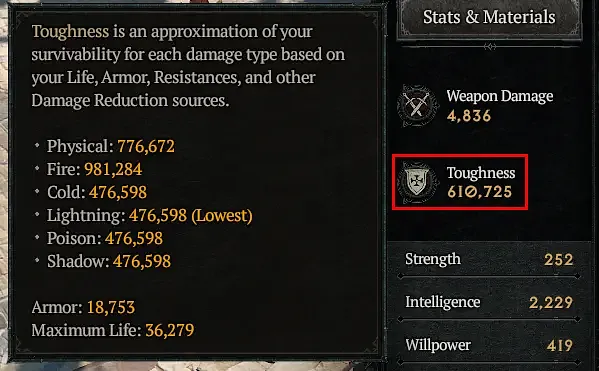
Importantly, Toughness is not a defensive stat itself. Instead, it estimates how much damage your character can take before dying. Toughness is mainly used to compare defensive changes. For example, when choosing between two items, compare your Toughness with each one equipped to see which is more effective.
However, a high Toughness does not guarantee survival. If one defensive layer, such as a single Resistance, is much lower than the others, damage of that type can still kill you quickly.
For a full breakdown of Toughness and how Armor and Resistances fit in, read the guide below.
((insert link to armor and resistances guide once written))
Maximum Life
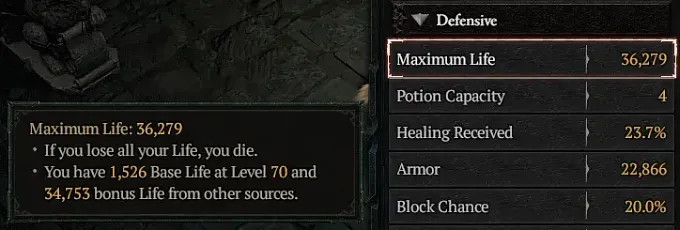
Maximum Life is the stat every other defensive layer builds upon. Armor and Resistances lower incoming damage, but your Life pool ultimately decides how many hits you can take. Many Barriers, Fortify sources, and healing effects also scale off Maximum Life, so increasing it strengthens all of them at once.
Where Maximum Life Comes From
Maximum Life primarily comes from two sources:
Flat Maximum Life. This is your Base Life from leveling, plus Maximum Life affixes and tempers on your gear. Weapons, especially two-handers, can carry particularly large amounts of Maximum Life.
Percentage Maximum Life. Typically found on Paragon nodes and set bonuses, this stat increases your total Maximum Life by the listed percentage. Multiple sources of % Maximum Life add together, so two
 2.0% Maximum Life nodes would equal 4.0% Maximum Life.
First, all of your flat Maximum Life is added together. Then, the total is multiplied by your combined % Maximum Life. Every % Maximum Life bonus is added to the same total, so each new source gives a smaller relative increase as that total grows. Once your % Maximum Life is already high, flat Maximum Life on gear can become the stronger option.
Recovering Lost Life
Many effects restore missing Life, including skills, aspects, and other mechanics. The most common ways to recover Life are as follows:
Healing Potions. Each potion instantly restores a percentage of your Maximum Life. Your potions refill automatically over time, and you can also pick up extra potions that drop in the world.
Life on Hit. Restores a flat amount of life every time you hit an enemy. Builds that attack frequently or have a large area of effect benefit most from this stat.
Life per Second. Steadily regenerates life whether or not you are attacking.
Fortify. This mechanic is explained in more detail below. In short, Fortify is a separate pool that gradually restores your missing Life after you take damage.
Barrier
Barrier absorbs incoming damage before it reaches your Life. It does not increase your Maximum Life. Instead, it acts as a temporary shield: when a hit lands, your Barrier takes the damage first, and only the remaining damage reaches your Life.
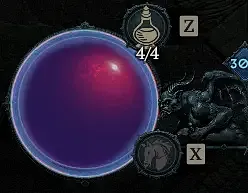
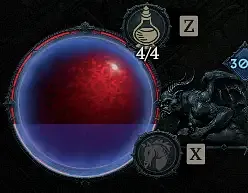
Barrier usually comes from class-specific skills and aspects, but some sources are available to every class. The  Que rune is an extremely powerful source of Barrier, and the
 Aspect of the Protector also works for any class.
Stacking Barriers
Barriers add together. Barriers from multiple sources combine additively, not multiplicatively.
Durations are separate. Each Barrier slowly decays on its own timer.
Total Barrier is capped at your Maximum Life. Any amount you generate over your Maximum Life is ignored.
Barrier only counts towards Toughness while it is present. If your Barrier comes from a skill on cooldown or a proc, your Toughness will jump when it activates and drop back down when it expires.
Making Barrier Stronger
Barrier Generation increases the amount of Barrier you gain and is available on gear affixes and tempers. However, nearly every Barrier in the game is a percentage of your Maximum Life, so raising your Life usually strengthens your Barriers more than increasing Barrier Generation does.
Barriers are best against big, sudden hits like boss slams and explosions because they absorb damage instantly. If your build keeps a Barrier up most of the time, you can safely rely on it for protection. If it only appears occasionally, treat it as a bonus rather than a layer you can rely on.
Fortify
Fortify is a separate pool that gradually restores your missing Life after you take damage. Unlike Barrier, it does not block damage. Instead, while you are missing Life, your Fortify slowly drains into your Life, healing you over time. How quickly this happens depends on your Fortify Drain Rate.

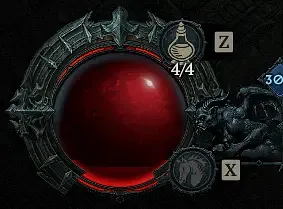
Technically, every class has access to Fortify through Raheir's Shield Charge skill. However, Shield Charge has a fairly long cooldown and provides little Fortify. Barbarians, Druids, Necromancers, Paladins, Rogues, and Warlocks also have class-specific ways to gain or benefit from Fortify through skills, aspects, and Talisman set bonuses. Examples include the Barbarian's  Steadfast Berserker's Aspect, the Necromancer's
 Fer of the Blood Binder, and the Warlock's
 Fortify.
How Fortify Works
Skills, passives, and aspects grant Fortify, usually as a percentage of your Maximum Life.
It is capped at your Maximum Life. As with Barrier, you cannot store more Fortify than your Maximum Life.
It heals you when you are hurt. While you are missing Life, Fortify drains into your regular life pool until you either run out of Fortify or are fully healed. It does not restore Life instantly.
You are "Fortified" while you maintain any amount of Fortify. You do not need to reach maximum Fortify for this status to be active.
The key difference from Barrier is that Barrier blocks damage before it reaches your health pool, while Fortify restores missing Life after the damage has already happened. Barrier protects your Life; Fortify restores it.
Making Fortify Stronger
Fortify Generation increases how much Fortify you gain from every source.
Fortify Drain Rate makes the Fortify heal faster. Mechanics like
 Embattled Aspect increase this stat.
Bonuses while Fortified. Some mechanics grant extra effects, such as Damage Reduction, while you are Fortified.
Because Fortify scales with Maximum Life, raising your life increases both your Fortify pool size and how much it heals per second.
Life, or Damage Reduction?
When choosing between stats like Maximum Life, Armor, or other forms of Damage Reduction, the right answer depends on your character's weakest area.
Increase Maximum Life when:
Your life pool is low compared to the damage you take, and enemies often kill you with a single hit.
Your build relies on Barrier, Fortify, or healing that scales off Maximum Life.
Choose additional Armor, Resistances, or Damage Reduction when:
Your life pool is already large, but many small hits are wearing you down.
One defensive layer is far lower than the others. Since each layer has diminishing returns, increasing your weakest layer will give the biggest relative gain.
Fortunately, you rarely have to choose between these stats. Often, increasing both is the best approach. The bigger trade-off is usually between defense and damage. Your gear slots, affixes, and Talisman charms are limited, so adding a defensive stat often means giving up an offensive one.
If you die often, especially to bosses or Elites, or if you have to play very carefully to stay alive, shift your build toward defense. If you rarely die but fights feel slow, shift toward damage instead. This matters most when bosses and Elites take a long time to kill, since every extra second gives them another chance to hit you.
When adjusting your build, change one thing at a time. Compare your Toughness and damage before and after, then test the change in the content that is killing you or slowing you down.
For a more in-depth look at Armor, Resistances, and other forms of Damage Reduction, read the guide below (coming soon).